来源:《中国日报》
发布时间:2026-07-09
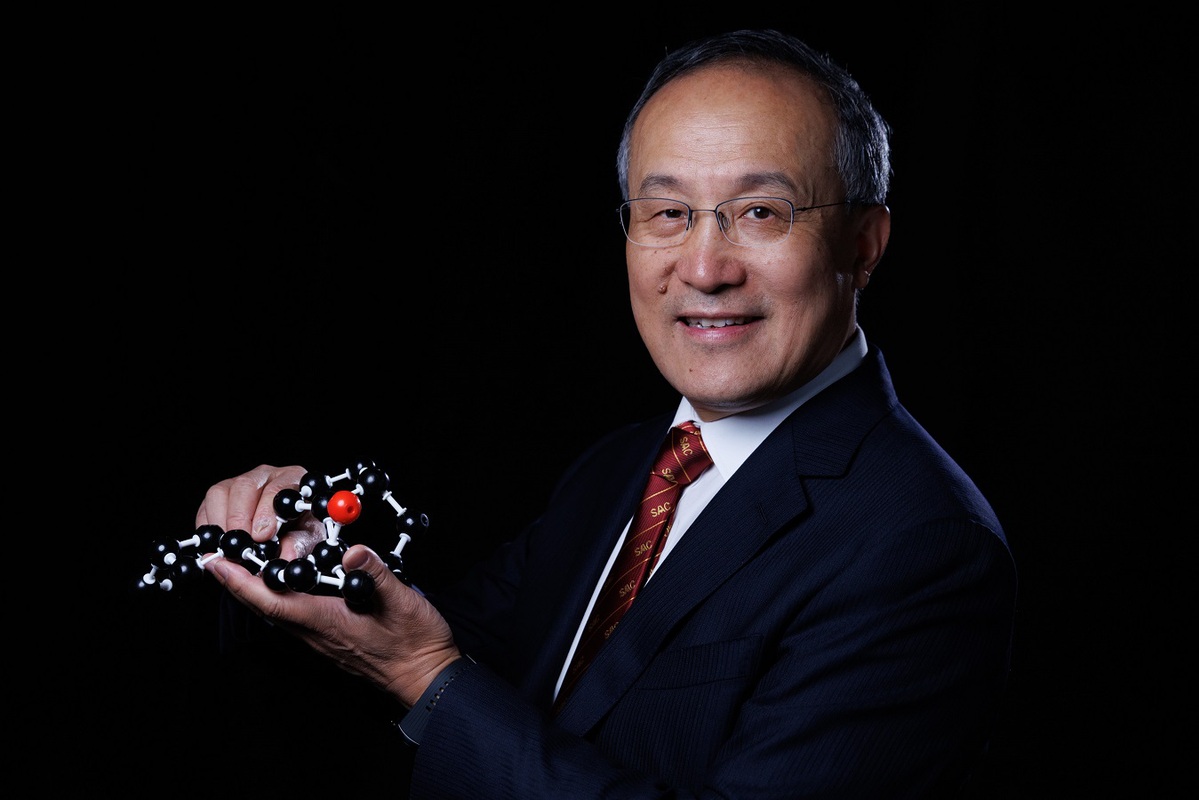
Research on single-atom catalysis by Zhang Tao and his team receives the first prize of the State Natural Science Award in Beijing on Wedensday. [Photo provided to chinadaily.com.cn]
As the invisible engines of modern chemistry, catalysts help produce the gasoline that powers cars, the fertilizers that grow food and the polymers used to make clothing — making them indispensable to modern life.
For more than a century, however, the chemical industry has grappled with a costly inefficiency: Its most effective catalysts rely on rare and expensive precious metals such as platinum and palladium, which are even more expensive than gold. Traditional industrial processes use these metals as nanoparticles or clusters, leaving up to 95 percent of the metal atoms buried and inaccessible to reactants, severely limiting efficiency.
After decades of research to address this challenge, Academician Zhang Tao and his team proposed the concept of Single-atom catalysis in 2011, in which individual metal atoms are isolated and dispersed on a support, with each atom serving as an independent active center. The approach raises atomic utilization from just a few percent to nearly 100 percent.
The breakthrough, first demonstrated with platinum-group metals and later extended to more than 40 elements across the periodic table, received the first prize of the State Natural Science Award in Beijing on Wednesday in recognition of its fundamental role in reshaping the field of catalysis.
"The defining feature of single-atom catalysis is its ability to advance our understanding of catalytic active sites — where reactants are transformed into products — from the conventional micro- and nanoscale to the atomic scale," said Zhang, a member of the Chinese Academy of Sciences and a professor at the Dalian Institute of Chemical Physics, CAS.
"Through theoretical studies, we have not only elaborated on the reasons for the stability and dynamics of single-atom catalysts, but also mapped out their role in regulating chemical reactions," said Li Jun, a team member who is also a CAS member and a professor at Tsinghua University.
"This has transformed our understanding from blindly 'stir-frying in a black box' to rationally designing catalytic processes," Li said.
Zhang said the mechanistic understanding has broad applicability, spurring global interest in translating the concept into industrial applications ranging from pharmaceutical manufacturing to the production of fine chemicals. Thousands of research groups from nearly 100 countries and regions have published more than 20,000 papers on the subject.
"This is not merely an academic pursuit, but a strategic response to national needs," Zhang said. "Securing independent control over core catalyst technologies is vital for our energy security and chemical industry."
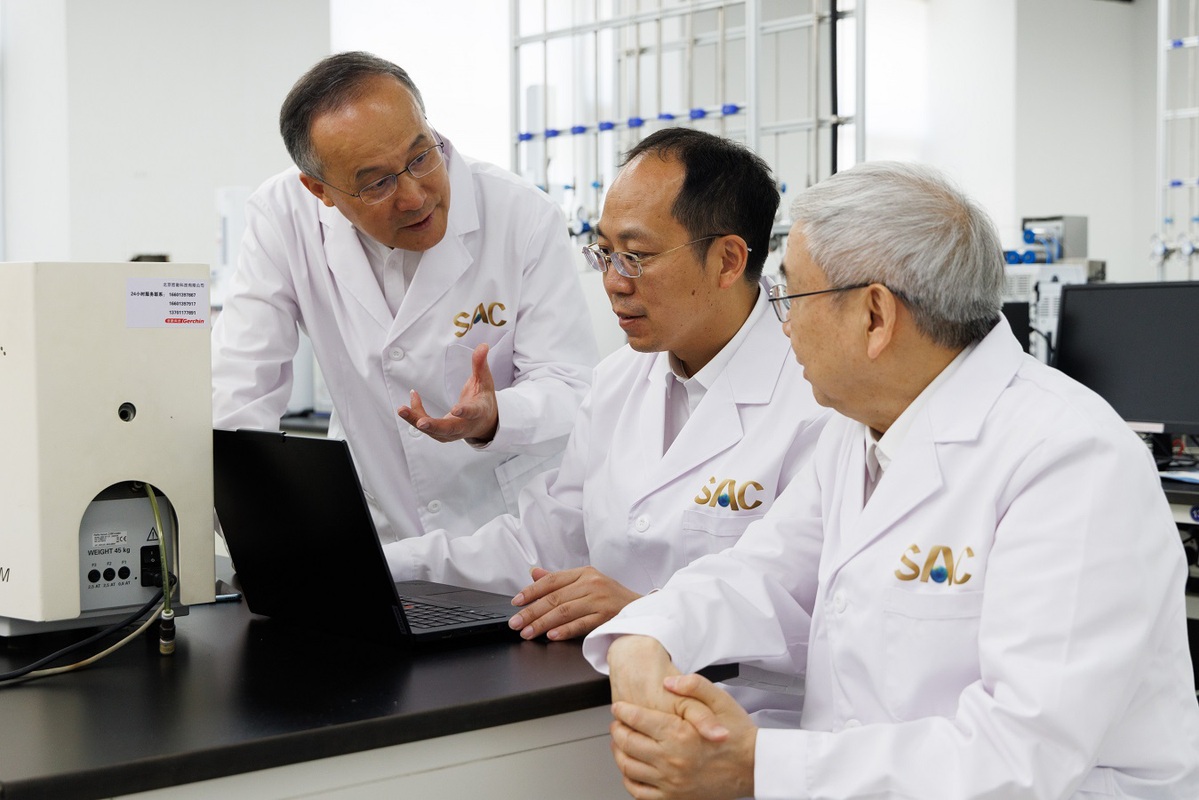
Zhang Tao, Yang Xiaofeng and Li Jun (from left) discuss their research in a laboratory. [Photo provided to chinadaily.com.cn]
Behind the achievement lies a decades-long journey from hypothesis to validation. In the 1980s, when the concept first appeared as a speculative idea in Zhang's doctoral dissertation, the tools needed to prove it simply did not exist.
"In the beginning, we had the idea but no means to see it," Zhang said. "It felt as if an elephant stood right in front of you, yet in the pitch-black darkness, without a flashlight, and with the path choked by weeds, it remained invisible."
The technical limitations of the time compounded the challenge. The domestically produced chromatograph used by the team was rudimentary and plagued by severe signal fluctuations, while power outages were common.
"Often, just as you were about to collect the final data, the power would flicker, erasing an entire day's work," Zhang recalled. He often spent days in the laboratory, sleeping on a simple straw mat on the floor while waiting for the data to stabilize.
Zhang attributed his persistence in part to his early experiences in the mountains. Born in 1963 in Ankang in the Qinba Mountains of southeastern Shaanxi province, he returned to his hometown to teach at a high school after graduation. Driven by a deep fascination with scientific research, he later decided to pursue graduate studies.
"I taught during the day and studied for my master's exams by lamplight at night, wrapped in a thick cotton-padded coat and felt boots to ward off the winter cold," he said, adding that the period of self-discipline instilled in him the independence and perseverance that later helped him endure repeated research setbacks.
"Set a clear goal and keep going. That's how you do unique work," Zhang often tells his students.
Zhang emphasized the importance of interdisciplinary collaboration throughout the research. He led the synthesis of the catalysts and performance testing, bridging the gap between theory and practical application, while Li Jun, a theoretical chemist, developed the theoretical framework explaining the stability and reactivity of single atoms.
"With advances in artificial intelligence and computer simulation, we are now leveraging our fundamental understanding of active sites to rationally design and screen catalysts. This integration is poised to serve as a critical bridge, driving forward global new energy development and the green chemical industry," Zhang said.
以下是该媒体报道地址:https://www.chinadaily.com.cn/a/202607/09/WS6a4f5725a310986e2b4646ad.html